Clinical need
About 1 in 3 people with schizophrenia-spectrum disorders in the reviewed studies had treatment resistance.
Based on a review of 50 studies.
Brazilian Journal of Psychiatry, 2023We help clinicians and health systems deliver timely, safe, evidence-based care—through consultation, education, and hands-on implementation support, so people get the right care from their own providers.
Connecting clinicians and health systems to expand access to evidence-based care
The TRS ACCESS Network is part of the Psychosis Clinical and Research Program at Massachusetts General Hospital. We partner with clinicians and health systems to improve care for people with treatment-resistant schizophrenia (TRS).
ACCESS stands for Advocacy, Clinical Consultation, Education, and Support Services. Our network brings together clinical expertise and practical implementation support to help care teams establish and sustain services for clozapine and long-acting injectable antipsychotics.
 Courtesy of Oliver Freudenreich
The TRS ACCESS Network is supported by the generous philanthropy of the CNR Foundation.
TRS is common, but clozapine remains rarely used.
Based on a review of 50 studies.
Brazilian Journal of Psychiatry, 2023Adults with psychotic disorders across 11 U.S. health systems (2019 data).
Journal of Clinical Psychiatry, 2024Estimates for people aged 15+, based on medication-volume data.
Estimated use was below 0.10% of the population aged 15+ in these countries, compared with the authors’ 0.20% benchmark for potential need. These are population-level estimates, not a direct count of eligible patients treated.
Abigail Donovan, MD explains our mission
Learn how TRS ACCESS helps clinicians prescribe clozapine and long-acting injectables safely and effectively for people with TRS.
 Courtesy of Oliver Freudenreich
A lighthouse is a beacon of hope in a sea of uncertainty.
Clozapine is proven to be the most effective treatment for TRS, but many people never receive it. The TRS ACCESS Network exists to close this gap by supporting earlier, safer, and more consistent use of clozapine and other best-practice interventions.
We partner with clinicians, clinics, and health systems to:
Abigail Donovan, MD explains the importance of improving health outcomes
Measuring and improving outcomes for people with TRS can transform lives and healthcare delivery. Our focus on outcome-based care helps ensure that every intervention leads to meaningful improvements in well-being and recovery.
Expert clinicians dedicated to TRS ACCESS services

Director, TRS ACCESS Network
Professor of Clinical Psychiatry, Harvard Medical School
Co-director, MGH Psychosis Clinical and Research Program
Oliver Freudenreich leads the consultation service for clinicians managing complex psychosis.
View publications
Associate Director, TRS ACCESS Network
Assistant Professor of Psychiatry, Harvard Medical School
Director of Clinical Services, MGH Psychosis Clinical and Research Program
Abigail Donovan specializes in early detection, treatment, and quality improvement for schizophrenia care.
View publications
Assistant Professor of Psychiatry, Harvard Medical School
Medical Director, MGH Clozapine Clinic
Carol Lim directs the MGH Clozapine Clinic and helps health systems establish safe clozapine monitoring programs.
View publications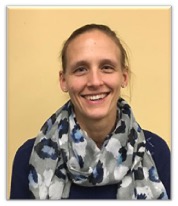
Psychiatric Nurse Practitioner & LAI Specialist
Sarah Maclaurin provides clinical care, consultation, and training focused on long-acting injectable antipsychotics.

Assistant Professor of Psychology, Harvard Medical School
Clinical Psychologist & Implementation Specialist
Cheryl Foo leads implementation support for safe, effective clozapine and long-acting injectable services.
View publications
Program Coordinator
Marta Hernandez coordinates program activities and supports patient care and daily operations.

Program Manager
Leah Namey manages TRS ACCESS operations and quality improvement initiatives.
Comprehensive support for evidence-based TRS care
Direct clinical services and case consultation
Expert consultation for clinicians managing complex cases of difficult to treat psychosis, providing guidance on diagnosis, treatment planning, and clozapine initiation and management.
Helping clinics and health systems build the capacity to deliver safe, effective TRS care
We specialize in optimizing clozapine treatment, navigating today's regulatory landscape to ensure safe, effective prescribing. Our support includes protocol development, staff training, and education to uphold best practices in clozapine management.
Training and consultation on long-acting injectable antipsychotic medications, helping clinicians optimize medication adherence and improve treatment outcomes.
Implementation support to help healthcare systems and clinicians become capable of prescribing clozapine and long-acting injectable safely and effectively, including staff training, workflow development, and ongoing support.
Dr. Cheryl Foo is helping advance efforts to expand access to long-acting injectable medications across Massachusetts.
The SMI-REACH Summit, sponsored by the MGH Center of Excellence for Psychosocial and Systemic Research, brought together state agency and behavioral health partners, community behavioral health center leaders, providers, and academic experts, with participation from TRS ACCESS Network members. The summit focused on shaping a coordinated statewide strategy to expand access to long-acting psychiatric medications for people with serious mental illness and substance use disorders.
Read more about the event here: https://tinyurl.com/smi-reachsummit
MGH TRS ACCESS Network and Makerere University collaboration advancing schizophrenia and clozapine care in Uganda
Our faculty offer practical teaching on schizophrenia care, including TRS, clozapine, and long-acting injectable antipsychotics.
Planning Grand Rounds, a lecture, a case conference, or another educational session? Tell us about your audience and what you would like to explore. We welcome requests for other topics and formats.
Educational materials and publications from our faculty
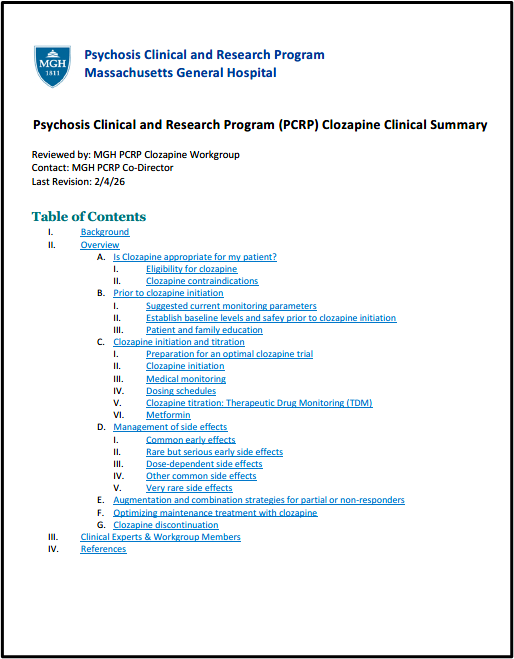
Evidence-based clinical guidance from the MGH Psychosis Clinical and Research Program.
With the removal of the federal clozapine REMS program, simplified monitoring requirements, and updated clinical guidelines, there are fewer barriers to clozapine access than ever before.
View / Download PDFA framework for organizing clozapine monitoring across the trial, optimization, and consolidation phases.
View ArticlePractical lessons for introducing point-of-care fingerstick monitoring in outpatient clinics, including patient preferences, staffing, and financing.
View ArticleA review supporting earlier clozapine use in TRS, with practical strategies for safe treatment and overcoming barriers to care.
View Article
A practical guide to understanding and treating psychotic disorders (second edition).
View book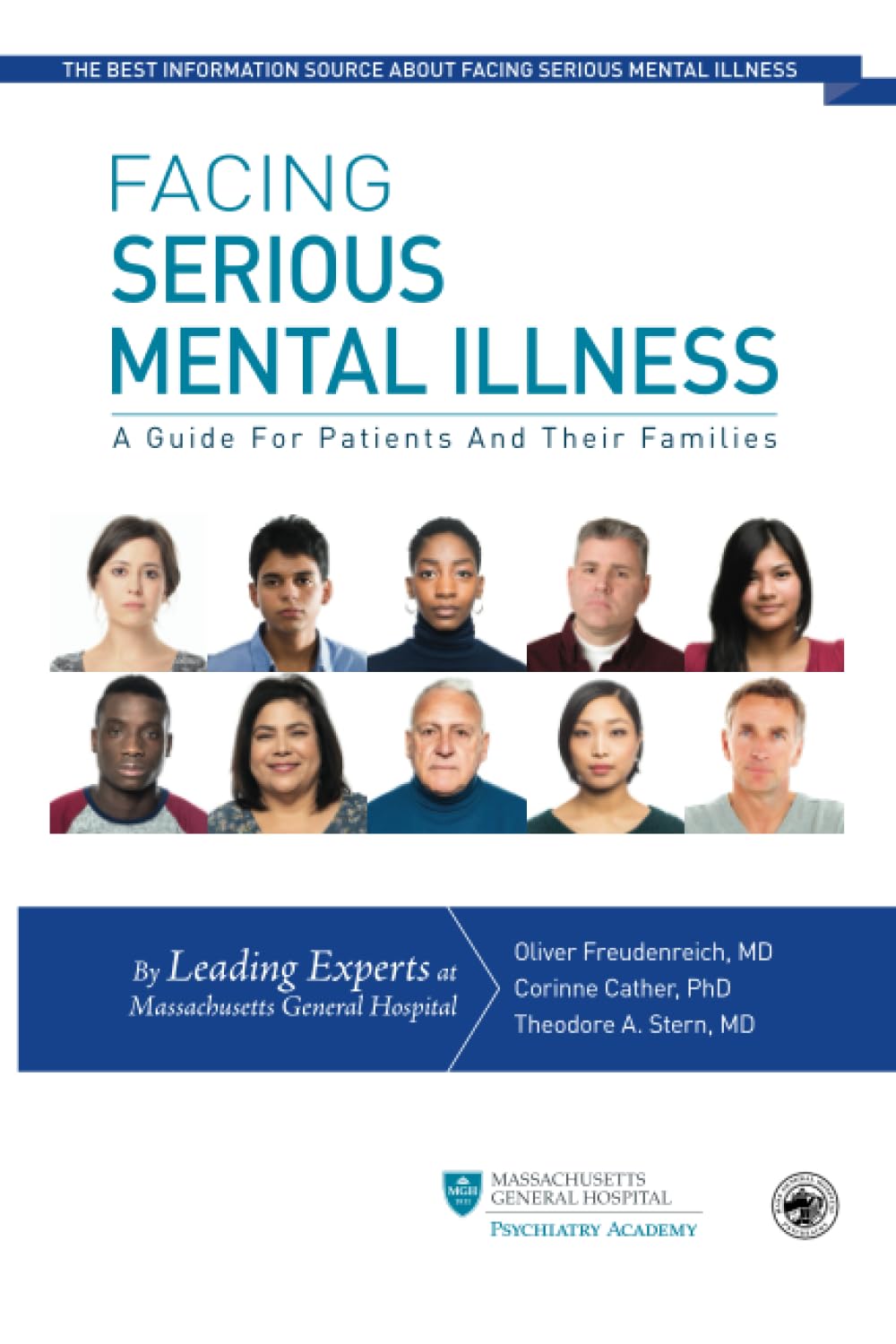
Guidance for navigating the challenges of serious mental illness.
View book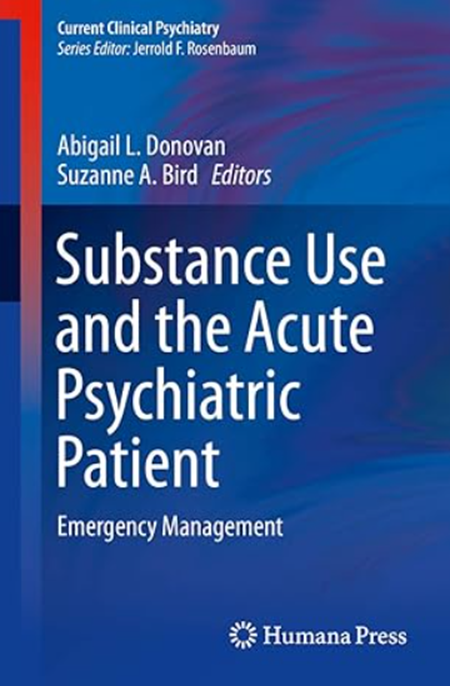
A guide to managing substance use in psychiatric emergencies.
View book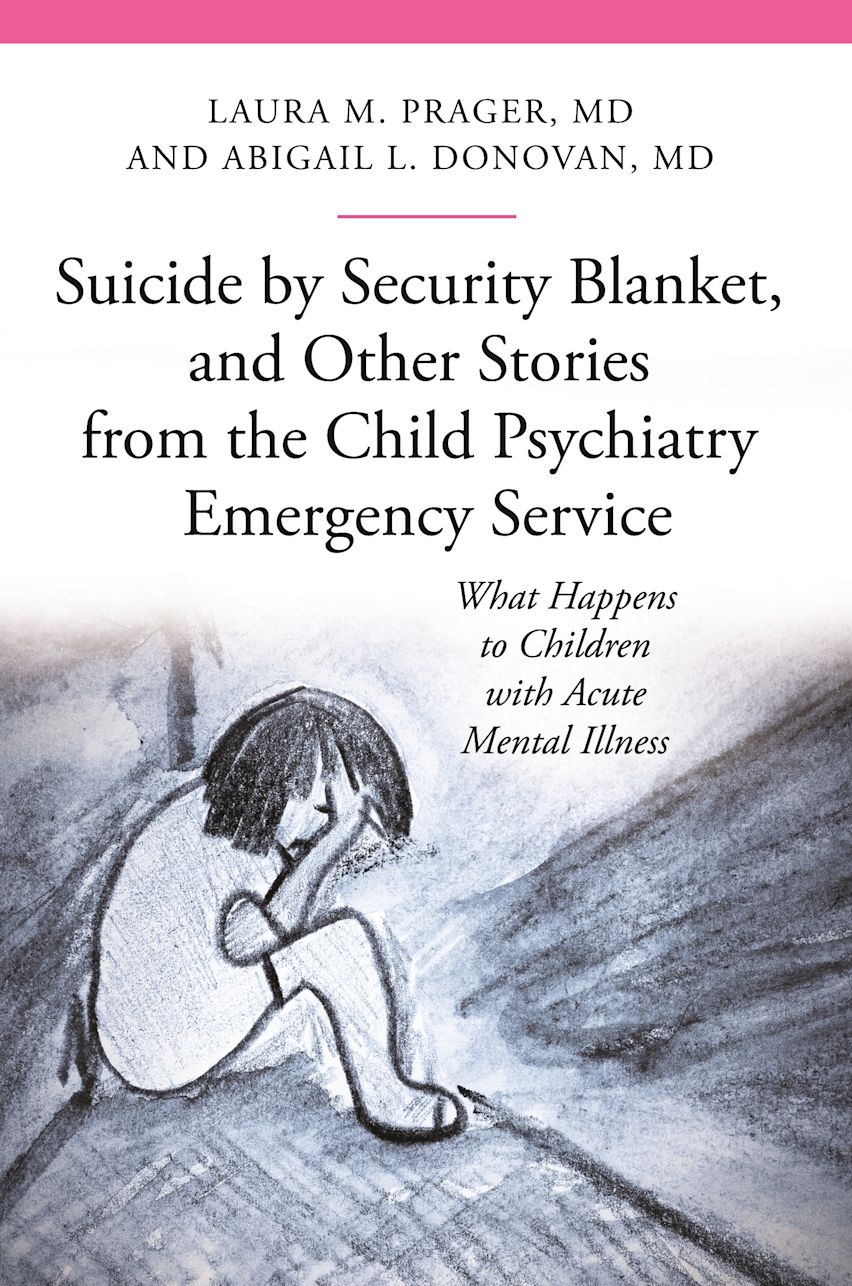
Stories offering a window into the world of emergency psychiatry.
View bookOliver Freudenreich, MD explains how to assess possible causes of secondary psychosis.
Abigail Donovan, MD introduces schizophrenia, its symptoms, and treatment approaches.
Oliver Freudenreich, MD discusses progress and challenges in community psychiatry at MGH Schizophrenia Education Day.
Oliver Freudenreich, MD calls for better care for people facing both mental illness and cancer.
Get in touch with our specialized team
151 Merrimac St, Suite 401
Boston, MA 02114
617-643-1175